|
Church Music in NE Scotland in the Eighteenth and Nineteenth Centuries
by David Welch
In 1690 the Church of Scotland divided, an event that significantly affected sacred music in the next two centuries. The thirteen Scottish bishops had their authority rejected because they continued to support James II and VII, deposed in 1689 for Catholic sympathies. The division was messy and slow, with some ministers holding on to their parishes despite still accepting bishops. Efforts to hasten the purge were made by the reformed Church of Scotland Assembly and by the parliaments in Edinburgh and later London. Acts were passed requiring acceptance of the Westminster Confession and oaths of allegiance to the Royal family. As a result some ministers were ejected from their churches and even imprisoned for failing to comply.
In north-east Scotland Episcopalians were much more numerous than in other parts. So here ousted Episcopalians built substantial new chapels or sometimes were allowed to occupy former kirks. An indication of Episcopalian strength comes from the "rabbling of Deer" when in 1711 a crowd of several thousand Episcopalians gathered in and around the kirk of Old Deer and managed to prevent the installation of the first minister appointed there by heritors (local landowners) acting outside bishops' authority.

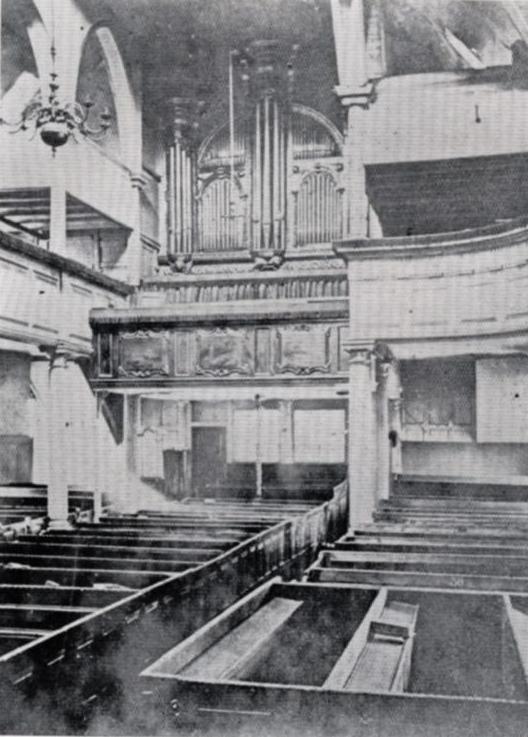
Fig.1. The organ and west end of
St Paul's Chapel, Aberdeen.
During the 1715 Jacobite uprising some ejected ministers reclaimed their former kirks, but harsher Government measures came afterwards. Gatherings of more than 9 persons at services led by clergy refusing to take the oath of allegiance were outlawed. This brought about a further denominational split: in the north-east many ministers took the oath and their many supporters approved, forming Qualified Episcopalian congregations which were at once disowned by the bishops. The remnant Non-juror congregations controlled by the bishops met mainly in houses and stayed a very minor sect until late in the century.
In Aberdeen, the largest Episcopalian congregation set about building their new chapel, St Paul's, in 1720, aided by many aristocratic families, merchants and the Town Council. An organ was installed in the west gallery of this large church, and in 1726 an English visitor recorded that "the service was chanted, as in our [English] cathedrals". The organ was the largest in a Scottish church for many years, and remarkably there is a photograph showing it, or at least its 1722 case, taken c.1865 shortly before St Paul's was rebuilt (1) (Fig.1).
Sang Schules
These institutions had been reinstated in all burghs after the Reformation, and taught boys church and instrumental music and often arithmetic, reading and writing. The best of them in the seventeenth century was in Aberdeen according to Purser (2). From the "maisters" of this school came both the celebrated Scottish Psalter of 1635 with tunes in four-part harmony, some fugal "in reports", and the Cantus, Songs and Fancies partbook of John Forbes (1662, 1666 and 1682), Scotland's first published secular music (2). This last included a setting of the Remember O Thou man carol that caused problems to the Mellstock choir.
The masters of sang schules usually had the position of precentor in the main town churches, and led the singing helped by the boys they had trained. In Aberdeen the main church, St Nicholas, had been divided by a central wall since the Reformation, but Johnson believes that early in the eighteenth century singing boys were being supplied to both congregations as well as to the Trinity Chapel (3). This was the first refuge for the ousted minister and congregation of West St Nicholas Kirk, but was forced to close in November 1717. The congregation then decided to set up St Paul's with a Qualified minister, and John Schroeder/Sharreter and Andrew Tait, who were successively organists at St Paul's, are known to have taught in the Aberdeen Sang Schule.
In the eighteenth century sang schules were generally in a poor state in Scotland, and Aberdeen's one had closed by 1758. However its role had been taken over by Robert Gordon's Hospital, a boys' school opened in 1750. The music teachers at Robert Gordon's nearly always also held the precentorship of the West Kirk, and selected boys were for long part of that choir. However in 1840 boys from Robert Gordon's began to help the singing in the new North Church, and a letter of protest followed from the West Kirk Session to the school governors (4).
Music in the Church of Scotland before the mid-C18 revival
Prayer and preaching were the main elements in services, and the singing was simple and unaccompanied. Normally just two psalms were sung. The precentor gave out the lines of the verses usually in pairs, pitched the gathering note, and then proceeded at a slow pace, embellishing the air with graces.
Very few tunes were employed: it is often stated just twelve, but the contents of the Aberdeen psalters titled The Twelve Tunes of the Church of Scotland (published in 1666 and 1706) show that the twelve were common-metre tunes. So psalms in other metres would need further tunes taken from earlier psalters. Despite the titling, the 1666 psalter contained 14 tunes, one DSM, and the 1706 psalter 13 tunes, the extra being Bon Accord in extended CM, with a fugal last line.
The practice of lining-out meant that the music could hardly be enjoyed in its own right, hence pressures built throughout Scotland for alternatives. In the north-east aristocratic heritors accustomed to Episcopalian worship were doubtless in the lead. In 1746 the General Assembly directed that lining-out should cease, but even in St Machar's Cathedral in Old Aberdeen this was resisted for several more years.
The Monymusk Revival
A landowner renowned for innovations in forestry and agriculture, Sir Archibald Grant, laird of Monymusk, was the main force in changing the style of singing in north-east Church of Scotland kirks. He took advantage of some English soldiers stationed in Aberdeen after the 1745-46 rebellion being proficient in the new way of psalm-singing then developing in England. He persuaded Thomas Channon, the leader of this group which apparently worshipped in St Paul's Chapel, to go to Monymusk to teach the new style, and paid for his discharge from the Army. Channon's teaching was soon successful, the Aberdeen Intelligencer of 26 November 1754 reporting "a method of singing the church tunes has lately been introduced . . . into several churches in this neighbourhood. The person who teaches it goes from one parish to another, and carries some of the best singers with him . . . By his skill in vocal music, and the use of a small instrument called a pitch-pipe, he has made great reform . . . We hear he is to come . . . to teach the boys of Gordon's Hospital".
In January 1755 Channon's singers gave "a specimen" of the new style in Aberdeen West St Nicholas. The arguments after this event first in kirk session, then presbytery and synod, are recorded in a series of reports and letters in issues of The Scots Magazine during 1755. By August an anonymous proponent of the new method, possibly Sir Archibald himself, could name thirteen parishes then using it, and Johnson (1972) considered that the old heterophonic style had been replaced in all the churches of Aberdeen by the end of 1756 (5).
The repertoire in kirks from revival to 1800
A table of tunes known to Channon's singers given in the Scots Magazine of July 1755 (Fig. 2) provides useful evidence for the early stage of the psalmody revival, but thereafter the main guide on what was sung comes from the contents of locally published psalmodies, which is not ideal.

Fig.2. The 18 tunes in the Monymusk repertoire, as listed in 1755.
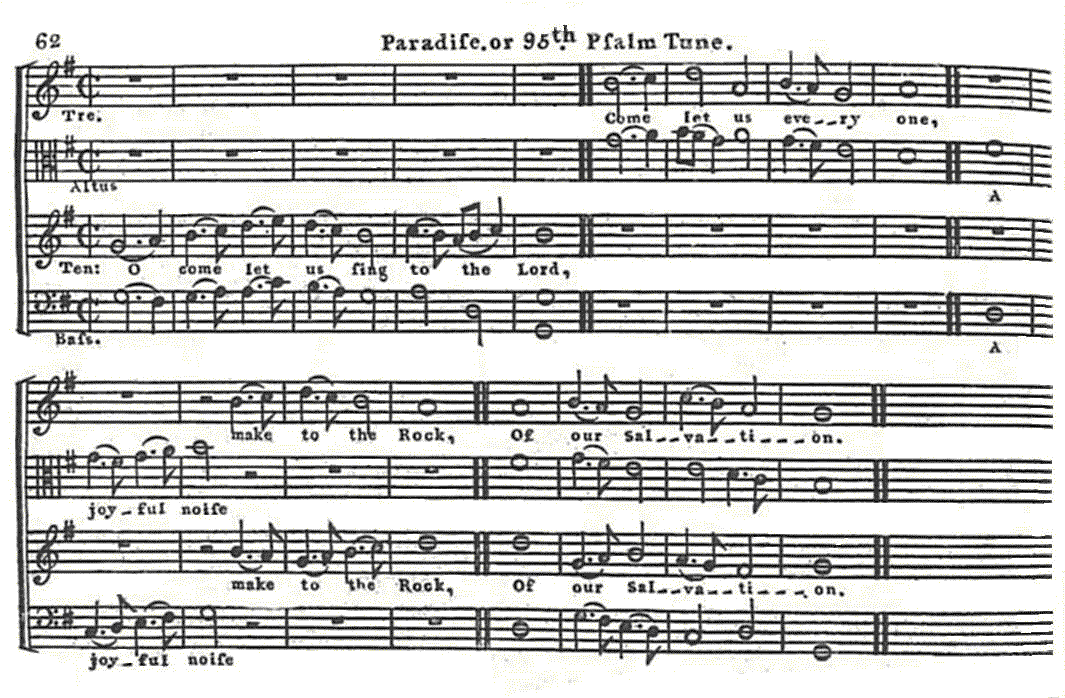
Channon's eighteen tunes included just one representative, Dundee (HTI = Hymn Tune Index 271), from the set of twelve common tunes, though the table footnote shows three more of these old tunes remained in use in some kirks (Dunfermline, French and Stilt which are respectively HTI 326, 327 and 331). London New, Psalm 100 and St Anne's had been previously available from Chalmers' Collection (1749), assembled by Andrew Tait, the St Paul's organist, but kirks are unlikely to have used this book. Four of the cheerful tunes, Abingdon, Zealand, Kidderminster and Colchester are very probably from Tans' Ur's 1735 collection, likewise the three melancholy tunes, Rugby, Bangor and Hartford; today's singers would not think the four lively despite their stated character. Just five tunes have dividing parts, Fintry, Monymusk, Paradise (Fig. 3), Kintore and Rayne (HTI 12953, 2423, 1195, 1193 and 4907), and interestingly these have Aberdeenshire names.

Fig.3. A dividing tune in McDonald's Psalmody, renamed after the Paradise woods at Monymusk.
Listen to the MIDI file.
The repertoire in kirks from revival to 1800.
Probably a printed book was brought out containing Channon's tunes. Possible evidence is found in a 1761 document about singing classes "... best if they practised with the notes, and for this purpose they should bring their books" (6). So the above attributions for tunes are not absolutely certain though supported by tune naming in later regional collections.
The psalmodies produced locally during the next stage of the revival are unfortunately sometimes undated, and for a key one the place of publication is not named and cannot be deduced. The earliest, from 1767, was printed in Aberdeen by the Chalmers' firm (HTI *SCT D a). Unlike its predecessor of 1749, this is clearly intended for the Church of Scotland since the paraphrases collected for that denomination in 1745 are bound in together with the Scottish version of the metrical psalms. The 1767 psalmody and undated successors printed by Chalmers (HTI #PDMCT a, #PDMCT b) contained only plain tunes. Dividing tunes are however well represented in Peter McDonald's undated and unlocalised psalmody (HTI McDoPP; date estimated as 1780 by Glasgow University library) and in William Taas' Elements of Music (Banff, 1787). McDonald included 17 of the 18 Channon tunes (the exception was Althorpe), and links are further suggested by two more Aberdeenshire village names (Kemnay and Premnay) being given to tunes.
Both McDonald's and Taas' psalmodies included nine anthems and canons and also chants, so they seemed partly aimed at Episcopalian congregations, but Taas' extensive preface shows his target market included Presbyterians. Collectively these psalmodies contained almost a hundred tunes, which fits with a widening of the repertoire towards the end of the century and perhaps also a greater number of items being sung in services.
Music in Episcopalian chapels to 1800
The main features differentiating Episcopalian music were chanted canticles and the use of instruments especially organs. The services were liturgical, mainly morning and evening prayer adapted from the English Prayer Book; full communion was infrequent (7) often just four celebrations a year. Much detail about the chanting is given by Wilson (8); the same few chants continued in use throughout the century, mostly paired to specific canticles.
Organs were bought for the Qualified chapels in Banff and Montrose soon after they had opened, but smaller chapels functioned with unaccompanied singing led by a precentor. Gradually more organs were installed but dates are uncertain. Peterhead Qualified Chapel bought a Snetzler in 1775 (9) and Trinity Chapel in Aberdeen was raising money to buy an organ in 1778 (10), but possibly these congregations were merely replacing organs. Towards the end of the century the restrictions on Non-jurors were eased and these congregations moved from their upper rooms into chapels and began to acquire organs (Peterhead by 1791, Aberdeen St Andrew's in 1795 (9).
The tune repertoire seemed to differ little between Episcopalian and Church of Scotland congregations, as evidenced by the similarity of the successive Chalmers psalmodies described above, and by the contents of the first tune collection clearly stated as being for Episcopal congregations (A Collection of Hymns . . . for the use of the Episcopal Church of Scotland, Aberdeen, 1790). This was small, with just a few extra hymn tunes such as Easter Hymn.
Singing lofts and their choirs
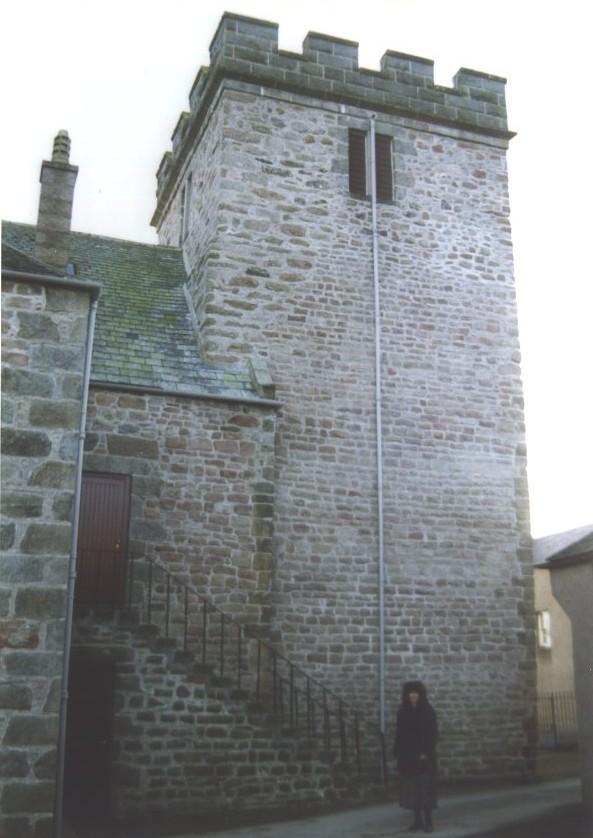
Many lofts were built to accommodate the new choirs (11), the reasoning for them being set out in the July 1755 Scots Magazine. The anonymous correspondent urged "... that a body of the singers sit together, generally in some gallery or loft, by which means they mutually assist each other, and lead the voices of such as are scattered in the body of the church, and command them more effectually than it is the power of any precentor to do". In August 1755 it was further reported that "the gentlemen and ladies usually contribute very generously to ease the poorer people of some of the expense of being taught, and to purchase psalm-books for them: and the heritors not only afford their countenance, but have also built commodious lofts or galleries for the performers, in churches where they were wanting". In Kintore in 1754 "the new loft which the Earl of Kintore had built and gave free to those who were taught to sing, contained about 120 people and had greatly slacken'd the body of the church" (12). Visible evidence remains at Rayne, the third parish to experience the revival according to the Scots Magazine report; at the top of an external stair to a side gallery the date 1754 is carved.
 |

External staircases to galleries at
Monymusk Kirk (left) and Dalmaik Kirk (above).
|
The choirs seem basically to have been three-part: at Huntly for example the new loft was divided into sections for cantus or treble, for tenor and for bassus (12). "The specimen" in Aberdeen West St Nicholas in 1755 was given by 18 basses, 30 tenors including 5 who sang counter in the 4-part tunes, and 22 female voices for treble or cantus. Taas in his Elements of Music recommended 15-20 bass, 15-20 tenor, 20-30 treble, and, if proper voices can be had, 3 or 4 counter tenor.
From descriptions of worship in two Presbyterian kirks in Keith (13), grouping of the singers in three parts continued into the nineteenth century, and the extended CM tune Monymusk, which has triple repeats of both its third and fourth lines sung by each part alone in turn, was still the introit every Sunday. Very probably Psalm 84 SV provided the words: "How lovely is thy dwelling place", as underlain to Monymusk in McDoPP.
Kirk music 1800 to 1850: the WG style's zenith
In this period services became shorter with more musical items, but precentors and psalms stayed supreme. Precentors varied much in ability and type, as Anderson described for Aberdeen city (14); they broadly reflected the outlook and social status of their congregations, being chosen by kirk sessions. West St Nicholas was top rank (15), and their precentors included William Maxwell Shaw (1797-1811), a pupil of the celebrated Edinburgh singer Peter Urbani, and John Knott (1811-1824). Knott had a splendid tenor voice and had sung in Durham Cathedral choir; he came from Kent and introduced tunes from that area, but was "greatly disliked" by the boys he taught at Robert Gordon's (14). Other more working-class congregations had locals as precentor, which perhaps helped tolerance of their foibles, like falling asleep in sermons and being intoxicated.
The make-up of psalmodies produced for particular congregations tells more about their singing. For West St Nicholas psalmodies appeared in 1801, 1814 and 1839, the two former being authored by Shaw and Knott respectively, the last by a committee (4). Only in Knott's collection do repeating tunes make a substantial contribution, an example being Queenborough. Probably the West Gallery style was too robust for this genteel congregation, and the lack of repeating tunes in the late C18 psalmodies # PDMCT a and # PDMCT b may also have resulted from this kirk being their intended market; James Chalmers of the printing firm was also the West precentor.
In contrast the East St Nicholas 1823 psalmody (Fig.4) was rich in the WG style, 39% of its 89 tunes being repeating, and its 1827 supplement containing "hymn tunes adapted to the particular metres used by congregational chapels" had 54% repeaters (4). Both collections were put together by William Maitland, the East precentor. Anderson praises him more for the tune book and arrangements than his voice, but added that some tunes were now thought "too secular" (14). A few tunes remained from the past (three of the "twelve common tunes", and nine of Channon's eighteen tunes including Monymusk), but most were newer like Hampshire, Lonsdale and Milbourne Port (HTI 10707, 4973 and 5314 respectively). Maitland set out his music on four staves and clearly had a four-part choir.

Fig.4 Title page of William Maitland's 1823 psalmody.
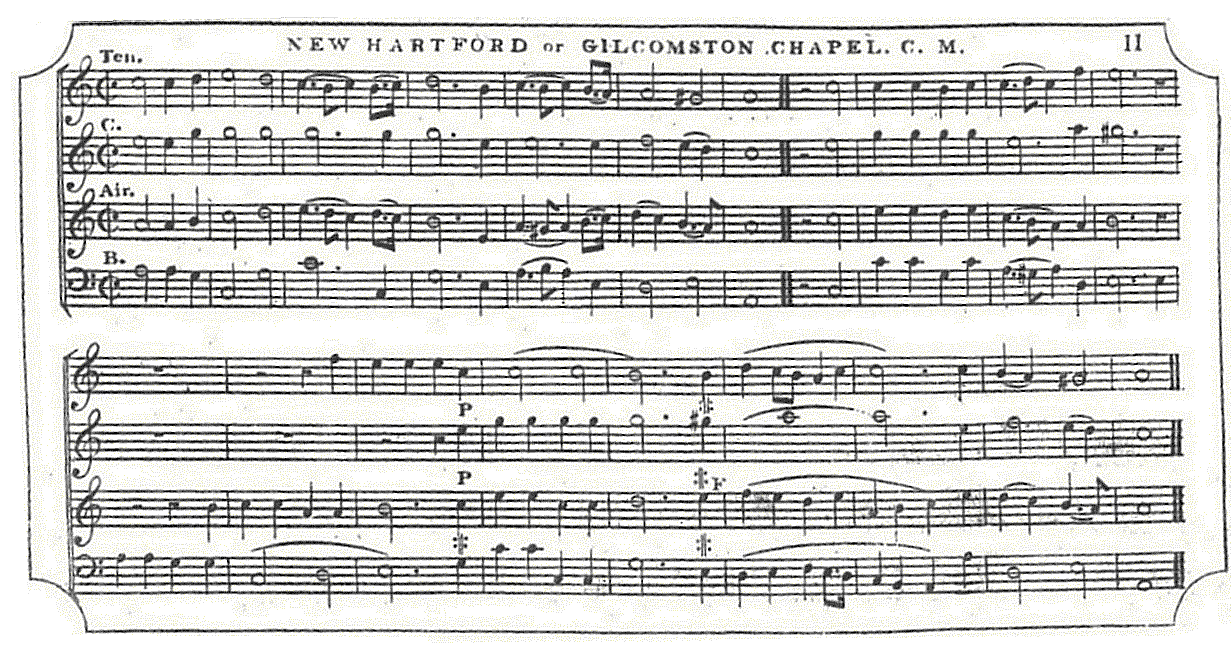
Ministering in the East Kirk at this time was the Rev.James Foote, and he was presented with a signed copy of the new psalmody by William Maitland on 24 April 1823. Foote was an accomplished musician and fine violinist, and in his copy seven tunes have been written out at the back by two neat hands, five of them on two staves as though intended for a keyboard player. All are new tunes except Gilcomston Chapel, which seems to have been rewritten because of three minor variations in the harmony compared to the printed version (Fig.5); an annotation reads "for the proper arrangement see end of book".

Fig.5 Printed version of Gilcomston Chapel, a tune perhaps composed locally c.1820.
Listen to the MIDI file.
Aberdeen Trinity Kirk also used Maitland's psalmody, and its choir had a strong bass line (14). The precentor regularly chose tunes with long bass solos including Missionary and New Henley (HTI 8388 & 11423). The choir was seated at the back of the front gallery, and "the heavy bass voices as they came rolling down from that remote end gallery, will not be forgotten by those hearers that remain" (14).
So it seems kirk music in Aberdeen was flourishing, with talent and tunes drawn in from around Britain, the repertoire revitalised and support from the clergy. To succeed in singing unaccompanied some of the longer fugal psalm tunes would need considerable practising by the choirs, good voices, and the precentors to conduct at times.
In the countryside some kirks in larger villages and small towns probably attained similar standards, judging from the contents of tune books. James Taylor, described as a teacher of music, issued two good collections at Inverurie and Kintore about 1820, while at Old Meldrum just five miles north of Inverurie John Sivewright became precentor of the kirk in 1819. Sivewright's operations as a singing master took him around the north-east from Auchenblae south of Aberdeen to Old Deer near the north coast and then Turriff (16), and his singing classes to which he rode on an old white horse were mocked (17). The enlarged 5th edition of his psalmody published at Old Meldrum contained 110 tunes and several anthems including Dying Christian and The Barren Fig Tree. Taylor's music was mainly three-part but two-part for some elaborate anthems, while Sivewright had a mixture of three- and four- part music.
In 1843 the Church of Scotland suffered a major upheaval with the Disruption, another split resulting mostly from arguments about patronage. In Aberdeen all fifteen ministers seceded into the new Free Church together with most members of their congregations (15). Many churches were then quickly erected including the iconic Triple Kirks with a central spire (of brick in a granite city) and three radiating naves for the Free East, Free South and Free West congregations. Implications for church music are obvious - more precentors and more singers needed - and I wonder if musical members of the congregations might have been more tied to their kirks if they had had organs.
C19 worship in Episcopalian chapels
The former Non-juror congregations expanded rapidly early in the century, and reconciliation between them and Qualified congregations was enabled by the 1804 Laurencekirk synod (7). At it, the Non-jurors accepted the 39 Articles, paving the way for some reunions, e.g. at Peterhead in 1812.
Services remained liturgical with chanted canticles. The small group of Scottish chants sung for most of the C18 seem to have survived into the C19, evidence coming from a letter of 1812 from John Skinner to Patrick Torry, a minister expert in music. The Forfar congregation were anxious to buy a barrel organ, but their minister was worried that the English builder would not be able to provide "our seven" Scottish chants on the barrels, and wanted Torry to supply the correct music for this(8). John Skinner was not totally conservative, since he was happy to have Cranbrook and Sicilian Mariners in the tune selection (18).
Use of metrical tunes did not expand until mid century, unlike in Presbyterian kirks. The 1847 collection of hymns "as used in St Andrew's Chapel, Aberdeen" contained just 55 texts grouped in pairs for particular Sundays and festivals and having 40 tunes recommended, e.g. Burford for a hymn for the Sundays between Epiphany and Lent and for a hymn for Good Friday. This was the 20th edition of the collection, the 4th being dated c. 1800 by HTI (#CHAEC). Prefaces in the early editions said the hymns had been chosen one for morning and one for evening service. The last edition seems to have been the 22nd of 1855, after which fuller hymn books were introduced.
In some chapels I believe instruments other than organs had a role. The choirmaster at St Andrew's, Aberdeen, was a fine flautist and played at many Aberdeen concerts, and in 1838 his daughter became the chapel organist. But only for St Mary's RC chapel in Aberdeen is it certain that a band led worship in this period: this chapel opened in 1860 and the band occupied the west gallery; there was no organ until 1887 whereupon the bandmaster's daughter became organist.
The St Andrew's choir also sang from the chapel west gallery next to the organ. However, on Christmas Eve 1848 the choir was moved to the front of the chapel by a new minister recently arrived from England, causing a walk-out of many in the congregation and the bishop's wife (19). Afterwards the choir regained the gallery for a few years, but moved permanently to the chancel as the High Church movement set in. Ultimately in 1914 this congregation decided to call themselves a cathedral, a change long avoided by Episcopalians who presumed they would eventually regain the ancient cathedrals lost in the 1690s.
Music in St Paul's Chapel flourished in the first decades of the C19 when John Ross was organist. After the Battle of Trafalgar it was advertised that the choir would sing a new anthem composed by Ross for the thanksgiving service (20), and a psalmody for the chapel issued in 1818 contained just over a hundred hymns, psalms and pieces like Dying Christian. In the 1840s the chapel joined the English Episcopalian Church (21), a denomination that only existed in Scotland, being made up of former Qualified chapels which still did not accept the Scottish bishops. Later its two ministers were at loggerheads, one now accepting these bishops, and gradually the congregation declined.
After 1850 in kirks: going simple and instrumental
Another movement of psalmody reform developed in Scotland in the 1850s, bringing a change to simpler, more refined, singing. The movement came to Aberdeen in January 1854 when William Carnie lectured to 2000 people in the Free West Kirk, and a few months later the Aberdeen Psalmody Improvement Association was set up (22). In 1855 it held its first meeting in the East Kirk with a choir "of 160 ladies and gentlemen including 20 leaders of psalmody ... illustrating various styles of sacred music". As a result some 900 singers attended instruction classes, which led to 26 congregational associations being formed.
Soon the Association was issuing its own psalmody, The People's Tune Book. The new edition of 1866 contained 154 tunes, very few repeating, and included a claim that 28,000 copies of the first edition, "the earliest popular tune book in Scotland", had been sold. In 1872 William Carnie expanded this book into The Northern Psalter, which became the main book of psalm and hymn tunes in the north-east, its spread across the area doubtless helped by the new railways. The Addenda Edition of 1877 claimed 72,000 copies had been sold, and in 1900 the claim was use of the Northern Psalter in over in over 80% of all churches in northern Scotland.
Singing in kirks was still unaccompanied and led by a precentor for some time after 1850. An early indication of change came in 1856 when the Psalmody Improvement Association requested the use of the Robert Gordon school organ (4) "for practisings and also in the East Church on Wednesday evening next at a public performance there". So it seems this chamber organ (said to have been a Snetzler (9) was regularly trundled through the streets, being needed for the school daily assembly but far more singers were in the association than could have fitted in the school for practices. The first organ in an Aberdeen Presbyterian kirk was installed in 1857, this in St Paul's Street Church that had arisen as a Relief Church, an early (1761) breakaway from the established Church of Scotland.
A large concert hall, the Music Hall, opened in Aberdeen in 1859 and had a 3-manual Willis organ placed centrally at the rear of the platform. An offshoot choir from the Psalmody Improvement Association, the Aberdeen Choral Union, was formed to perform in the Music Hall, and having organ accompaniment there further prepared Presbyterian members for instruments in their own kirks.
Organs eventually came to north-east CoS kirks in the 1870s, two in Aberdeen in 1875, and in the 1880s and 1890s many were installed. This occurred both in towns and larger villages, and also in Free Church kirks, e.g. a Willis 2-manual organ in Aberdeen Queen's Cross in 1889 costing £609. Some smaller villages acquired harmoniums, e.g. Marykirk in 1875 for £42, and in Aberdeen North Kirk, that had no organ, there was a fiddle band. Many of these organs were placed centrally on the end wall of kirks behind the minister's pulpit, perhaps inspired by the Music Hall organ. As a result choirs began to operate from the front of kirks clustered below or around the pulpit. However there are still today some CoS choirs operating from "west" galleries in the north-east, and enjoying this position.
Music files: MP3 - Monymusk (1m 58s; 927Kb)
MIDI - Paradise | New Hartford
References:
1. Welch, D. (2005) Further notes on pre-1820 organs in N.E. Scotland. British Institute of Organ Studies Reporter 29, No. 2: 16-21. Back
2. Purser, J. (1992) Scotland's Music, p.159. Mainstream, Edinburgh. Back
3. Johnson, D. (1972) Music and Society in Lowland Scotland in the Eighteenth Century, p.169-170. Oxford University Press, London. Back
4. Welch, D. (2000) Some developments in church music in NE Scotland from 1700 to 1880. Journal British Institute of Organ Studies 24: 94-107. Back
5. Johnson, op. cit., p.175. Back
6. Welch, D. (2006) Rules for the Rothiemay precentor, 1761. West Gallery 39: 24-25. Back
7. White, G. (1998) The Scottish Episcopal Church: a new History. Edinburgh. Back
8. Wilson, R.M. (1996) Anglican Chant and Chanting in England, Scotland and America 1660 to 1820. Clarendon Press, Oxford. Back
9. Welch, D. (2004) Organs prior to 1820 in North-east Scotland. British Institute of Organ Studies Reporter 28, No. 3, 14-19. Back
10. Walker, R.S. (1948) James Beattie's Day-Book 1773-1778, p.84. Third Spalding Club, Aberdeen. Back
11. Welch, D. (2002) A spate of singing lofts. West Gallery 21: 11-13. Back
12. Patrick, J.M. (1949) Four Centuries of Scottish Psalmody, p.160. London. Back
13. Welch, D. (2002) Some reminiscences on Keith singers. West Gallery 24: 22-23. Back
14. Anderson, W. (1876) Precentors and Musical Professors. Lewis Smith, Aberdeen. Back
15. MacLaren, A.A. (1974) Religion and Social Class: the Disruption Years in Aberdeen. Routledge & Kegan Paul. Back
16. Welch, D. (2005) A forgery of Sivewright's psalmody. West Gallery 34: 28-29. Back
17. Welch, D. (2002) John Sivewright - a Scottish singing master. West Gallery 19: 26-27. Back
18. letter of John Skinner in Scottish Archives CH12/12/2334. Back
19. Skene, W. (1905) East Neuk Chronicles. Journal Office, Aberdeen. Back
20. Aberdeen Journal, 27 November, 1805. Back
21. Gammie, A. (1909) The Churches of Aberdeen Historical and Descriptive. Aberdeen Daily Journal Office, Aberdeen. Back
22. Pratt, J. (1908) History of the Aberdeen Choral Union. Rosemount Press, Aberdeen. Back
HTI = Hymn Tune Index: for more information, go to Links page

|